by Tia Calvin | Oct 22, 2019 | News Slider, Student Spotlight
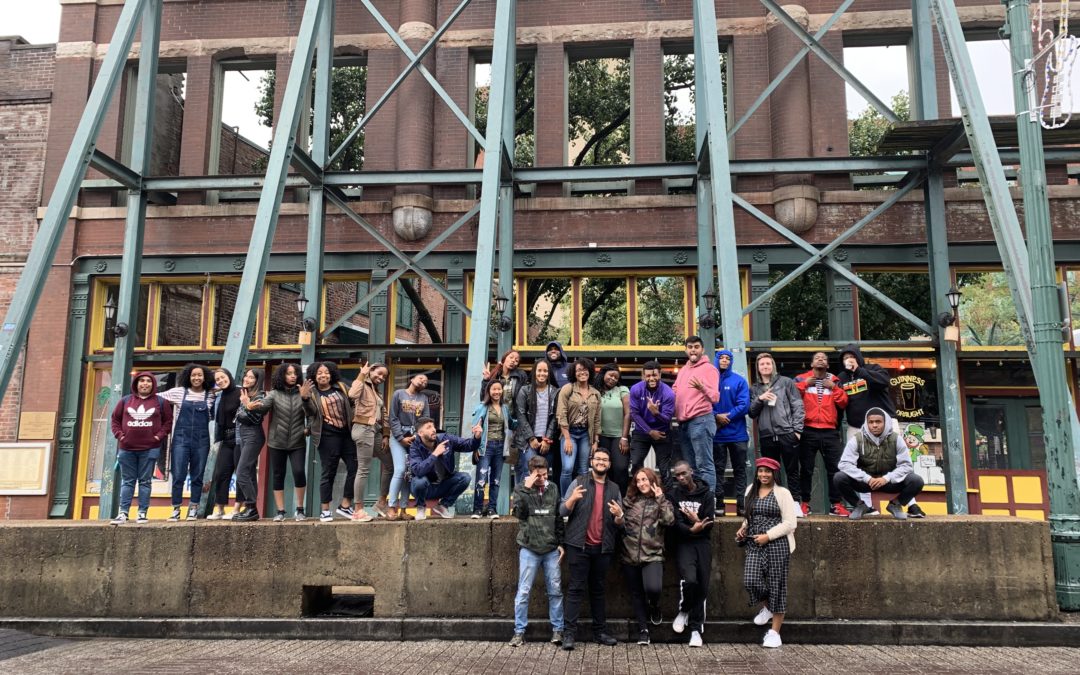
American musician Shawn Amos once said, “Memphis is the place where rock was born and Martin Luther King, Jr., was killed. It’s full of contradictions, abject poverty, and riches that only music can provide.” Lipscomb’s Office of Intercultural Development and Law, Justice, and Society program invited students to Memphis over fall break to witness this city’s unique dichotomy. Students first visited Beale Street, named by CNN Travel as one of the most iconic streets in America. These three blocks in the heart of downtown Memphis gave students a glimpse into the place where blues, jazz, and rock ‘n’ roll were founded. “As a music lover, I felt like I could feel my roots on Beale Street. It was heavily influenced by the past and that’s where most of today’s music comes from. Memphis is soul and you could feel it when you walked those streets,” senior Noah Kimbrough said. But, the ultimate purpose of the trip was to give students tangible insight into the struggles, sacrifices, and successes of the Civil Rights era and the people who gave the movement life. The National Civil Rights museum stands in conjunction to the Lorraine Motel, the balcony where Dr. Martin Luther King Jr. was shot and killed. Each exhibit within shows a different aspect of African American history, from transatlantic slavery of the early 1600s to the beginning of the Obama Administration in 2012. With a recent 200 million dollar update, the museum uses modern technology, live exhibits, artifacts, and film to give students an immersive look at Civil Rights. Lipscomb junior Eden Melles said that “the trip gave her a...
by Danielle Boyd | Feb 18, 2012 | News Slider
To take a deeper look into the history of the civil rights movement, a group of Lipscomb students traveled to the National Civil Rights Museum in Memphis, Tenn., at the Lorraine Motel where Dr. Martin Luther King Jr. was assassinated. The one-day trip was led by Dr. Lee Camp, a Bible professor, who sought to give students the opportunity to visit the history of the civil rights movement. Most students had never been to the museum, so it was “an eye-opening experience.” “It’s one thing to hear about it all the time, but to actually be in a place where history happened…it just made it so real for me,” said Natilan Crutcher, a Lipscomb student who went on the trip. The museum takes students through the history of African Americans from the early 1600s to the recent years of 2000-2012. The museum is made up of exhibits, artifacts, sculptures and remakes of events which led to the civil and human rights movement. “I came to this museum as a child, and I didn’t really know much about it,” said John Brownlee, a Lipscomb student from Memphis, Tenn., “but now that I am older I’m starting to appreciate it more, now that I understand the struggle of people like my grandmother and great grandmother.” For some students, the museum opened their eyes to appreciate life and the struggle of so many African Americans reaching for freedom, justice and equality. “I have a better understanding of how things went down,” said Lipscomb student Day Day Wells. Wells said the experience led her to think about the things people often take for granted such...
by Clay Smith | Apr 25, 2010 | News Slider
If any group of American children today was asked, “Can black and white people use the same bathrooms? Can they eat together at the same table in a restaurant?,” the answer would be a resounding, “of course.” Many children, teens, and young adults today will never be able to understand the hostile segregation that was prevalent in the South just 50 years ago. They owe this to the civil rights movement and to those who began to draw national attention to the movement in 1961: the Freedom Riders. The documentary Freedom Riders had its premiere Tennessee showing at Regal Cinema Green Hills as a part of the Nashville Film Festival on Wednesday, April 21. The film was followed by a question-and-answer session where actual Nashville Freedom Riders voiced their opinions about the movie and their experiences in the rides. The film was sponsored by Lipscomb’s School of Humanities, and was moderated by Norma Burgess, dean of the Lipscomb College of Arts and Sciences. Also in attendance were Ted Parks, associate Spanish teacher at Lipscomb, and Richard Goode, a professor of history at Lipscomb who teaches a class on the Civil Rights Movement. Freedom Riders takes an in-depth look at the journey of over 400 Americans who helped bring some of the first national attention to the physical abuses of protesters of segregation in the South. While teachers and history books give great detail in Dr. King’s involvement in the movement, the Freedom Riders get little attention. The concept of a Freedom Ride first arose from a group called the Congress of Racial Equality (CORE) in Washington, D.C. The group...
by Allison Woods | Mar 3, 2010 | News Slider
John Seigenthaler and Howard Gentry Jr. — two Nashvillians who were instrumental in the civil rights struggle — spoke to Lipscomb students as part of the observance of Black History Month. Seigenthaler, former editor and publisher of the Tennessean, worked as an adviser to Robert Kennedy and also covered the civil rights strugglet throughout the South. He was present at many of the sit-ins and white reactions. Growing up on the other side of the issue, Seigenthaler said he had to be educated on the struggles of African-Americans. “Martin Luther King had to expose it however he could and he had to dramatize it,” Seigenthaler said. He spoke of the freedom riders and Diane Nash leading the sit-ins in Nashville. He recalled the Ku Klux Klan attack in Alabama, perhaps the worst reaction of the nonviolent protests by African Americans. In Montogomery, Ala., Seigenthaler was hit in the head with a pipe and rushed to the hospital. Seigenthaler was with Robert Kennedy when he made his famous speech announcing the death of Martin Luther King, Jr. He remembered being the note taker when the two men first met. Gentry, the first African-American to be Vice Mayor of Nashville, grew up in segregated Nashville. His youth was filled with separate water fountains and second-hand textbooks. He was not allowed at the public swimming pool. Gentry said that his parents were the hopeful voice in his life. They taught him patience and hope for the future. He even remembered talking about John Seigenthaler in his home growing up. “There were people in the world that cared. And we will overcome, and they will help...
