by Erika Plunkett | Apr 10, 2020 | BREAKING NEWS, COVID-19, News Slider
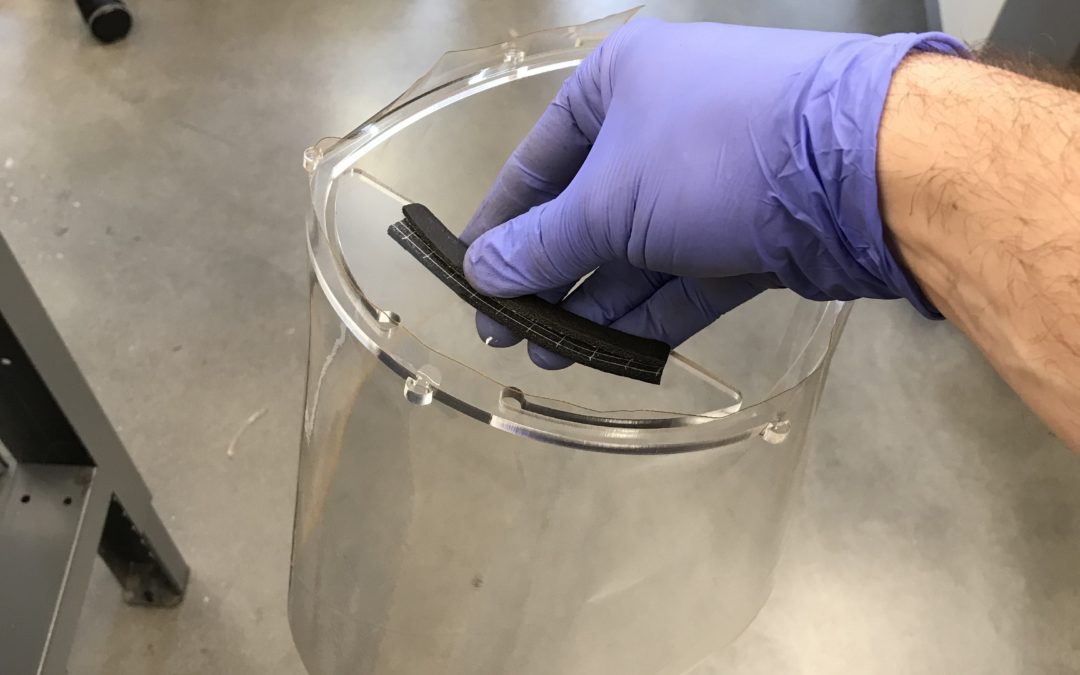
Lipscomb’s College of Engineering is busy protecting essential personnel who are participating in the mortal battle against COVID-19. The Raymond B. Jones College of Engineering has created and donated over 400 plastic face shields to medical personnel in the Middle Tennessee Area, and there are nearly 200 more currently in production. Leading this operation is Lipscomb’s Peugeot Center for Engineering Service headed by Steve Sherman, executive director, and Caleb Meeks, director of operations, along with Samuel Wright, the college’s engineering laboratory manager. “Connecting engineering capabilities with those in greatest need has been at the core of our engineering college and of the Peugeot Center,” said David Elrod, dean of the College of Engineering. “In this season, we are excited to find both virtual ways of staying connected with many of our international mission partners and to find new ways of serving our local communities.” These shields serve to help protect medical workers in the line of duty by placing a plastic mask in between practitioner and patient, protecting the eyes, nose and mouth from direct oral transmission from a patient. The design utilized by the engineers is an open source design originally created by Georgia Institute of Technology. “We’re using a high power, automated, laser system in our innovation lab to cut out the components,” said Elrod. “Having the tools in the innovation lab lets us readily produce face shields to help local providers.” As safety of the medical personnel is of top priority to the engineers, during construction of the shields, staff is adhering to strict CDC guidelines, wearing gloves and masks as well as limiting the number...
by Jake Morgan | Mar 22, 2010 | Opinion
On February 5th, 2010 I hopped off a plane in Guatemala City. As our team of eight loaded into our rental trucks only a few things were certain – The air was warm, I was hungry, and we were definitely not in Nashville anymore. After grabbing our first traditional Guatemalan meal at Burger King (“Rey de Hamburguesa” for our Spanish speaking readers), we began our four-hour trek northbound across the country to reach the mountain city of Coban. From what little I understood we would be spending the next two days working with the Kechi Mayans in the heart of Guatemala’s Ulpan Valley. As our caravan pushed further north, the landscape quickly changed from rolling hills to dry desert to the towering mountains of the Baja Vera Pas. If you’ve never driven in Guatemala, it’s hard to comprehend this ride is like. Basically, picture the worst mountain road you’ve ever experienced. Then, cut it down to a two-lane highway loaded with semis and logging trucks. Oh, and from my understanding, it takes at least seven policemen to issue a speeding ticket in Guatemala. This translates to all rationality of a speed limit going right out the window. So, here we are, driving at breakneck speeds down this winding two-lane highway, passing semi trucks while praying no one comes darting around the next corner. Consider it a religious experience. After somehow arriving safely in Coban, we took advantage of our quick journey and got a good night’s rest. The next day we would make the journey into the Ulpan Valley, also known as “The Corridor of Death.” When I had...
